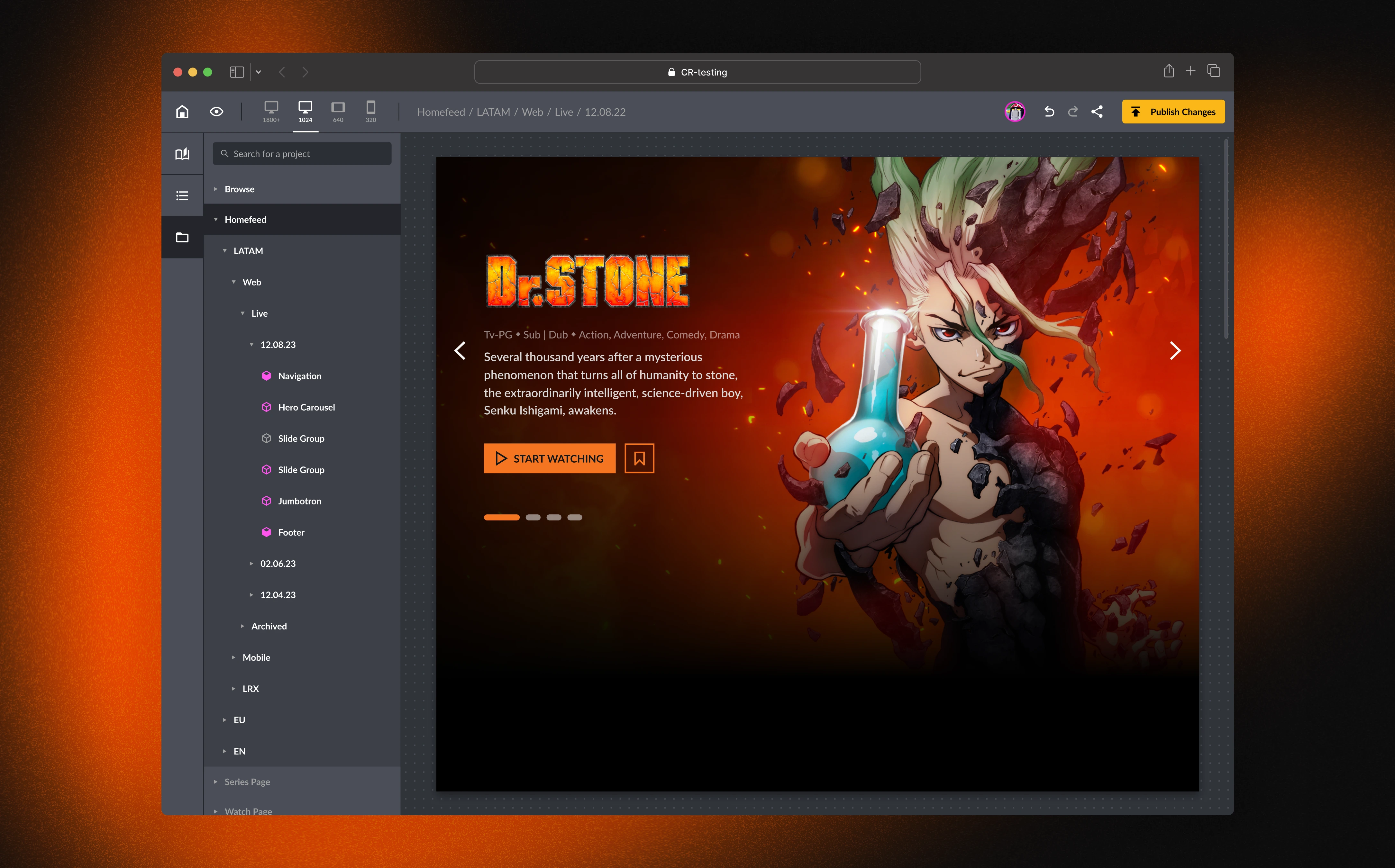
Crunchyroll's content editors were building home feeds for 200M+ users on tooling nobody had designed for the job. I replaced it in four months, working around their daily publishing deadlines.
Impact
- 50% less time per feed — 60 minutes down to 30, measured in time-motion studies
- 73% fewer manual publishing errors, tracked in Datadog
- 95% team adoption on day one, with no retraining program
The problem
Every region gets its own home feed: 67 regions, 10 languages. A misconfigured feed goes live instantly to millions of people.
The legacy admin tools made that high-stakes work harder than it needed to be:
- Feed creation took 60+ minutes of manual, error-prone steps
- No live preview — editors published to staging to check their work
- Every layout change required an engineering ticket
- No recommendations, no A/B testing, no scheduling
Editors had daily deadlines and were good at their jobs. The tooling was the problem.
Constraints
Four months to V1. The old system had to stay live in parallel, so there was no clean cutover. Users had daily publishing deadlines, so research had to work around them rather than interrupt them. And the recommendation engine was a third-party dependency, so I was designing around an API we didn't own.
Two decisions that shaped it
Depth over breadth. With four months and daily-deadline users, I shipped one thing well: the feed editor. Campaign Manager, Content Tagger, and Layout Control were explicitly deferred. That kept the scope achievable and the handoff clean.
Preserve the mental model. The old system was painful, but editors knew it cold. A clean-slate redesign would have thrown that away. Instead I mapped the existing workflow, kept the familiar terminology and layout patterns, and changed only what was demonstrably broken. That's where the 95% day-one adoption came from.
What shipped
A feed editor you can see
Live preview across breakpoints, drag-and-drop ordering, no staging round-trip.
Component library
Navigation, Hero Carousel, Slide Groups, Banners, Grid. Each one maps directly to what renders in the Crunchyroll app.
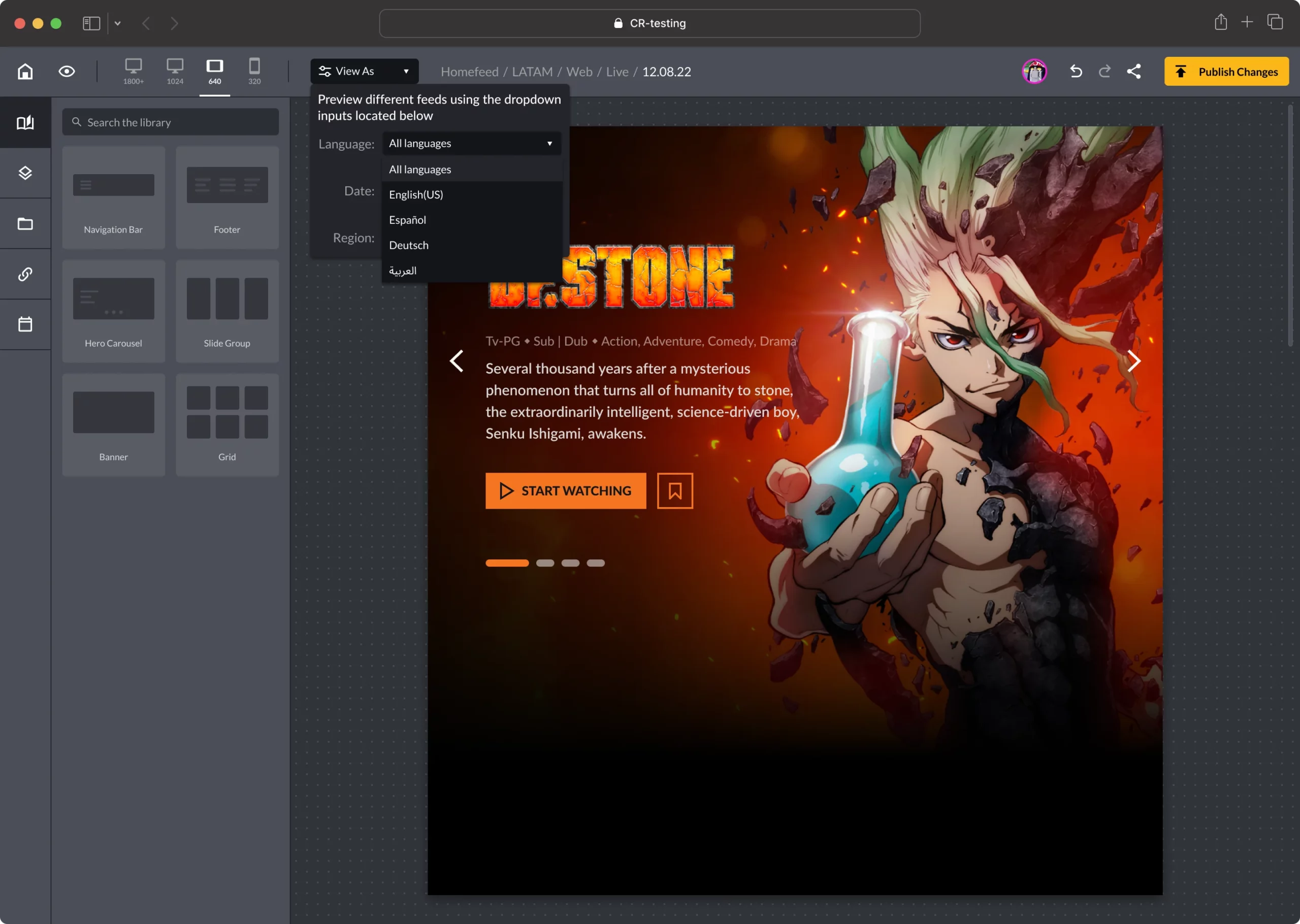
Regional targeting
67 regions with country-level control and per-component overrides.
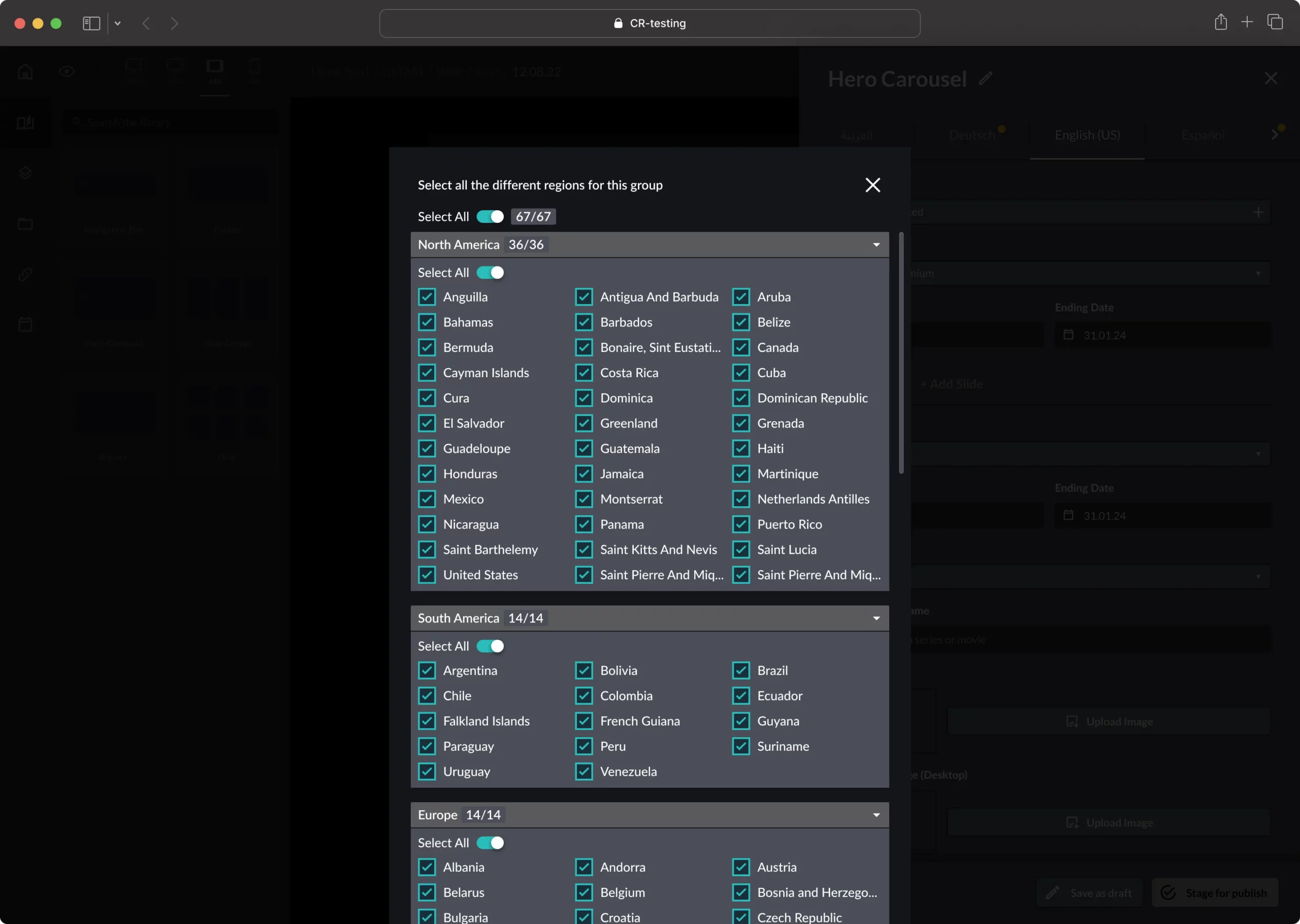
Editing content in place
Inline editing with live preview. No engineering ticket.
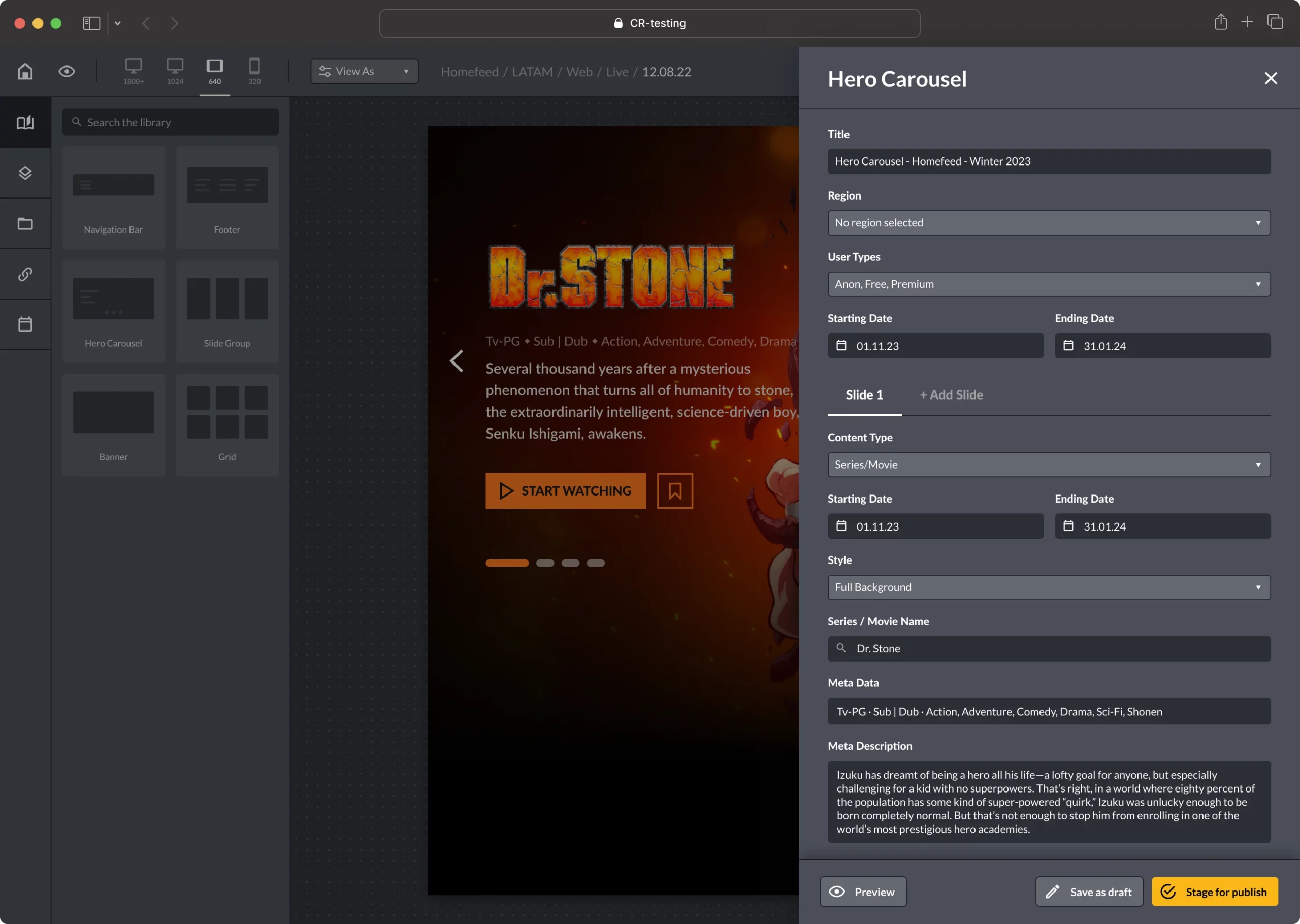
Layer drilling
Navigating nested components without losing your place.
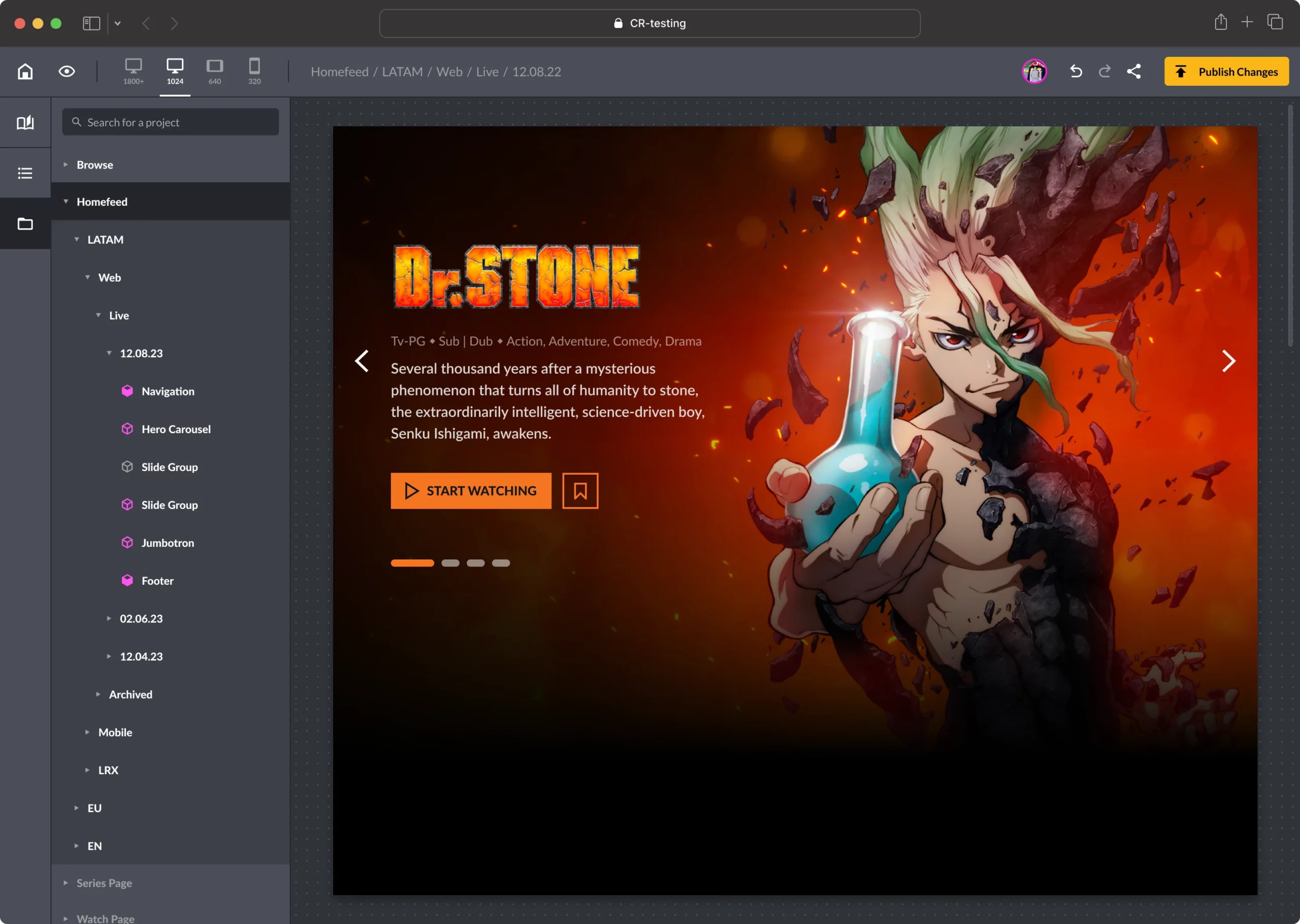
An early engineering prototype
One month in, engineering had already started building. This is what they showed me, before design had finalized anything.
Research, around the deadlines
I couldn't pull editors off their queue for long sessions, so I worked in the gaps:
- Shadowing during their actual publishing workflow — 20–30 minutes each, 8 sessions over 2 weeks
- Error log review with engineering, pulling the most common publishing failures from Datadog. This shaped the error-prevention features directly
- Hallway tests — 5-minute check-ins with printed wireframes between publishing sessions
The constraint made the research sharper. I couldn't afford to study hypothetical workflows.
What came next
The features deliberately deferred in V1 — Campaign Manager, Content Tagger, Layout Control — became the foundation for Project ATOM, a deployed prototype I built to show what the next generation of this tooling could be.